
September 21, 2026, marked the ninth anniversary of the significant amendments to the Patented Medicines (Notice of Compliance) Regulations (Regulations).
This past year saw the lowest number of section 6(1) proceedings commenced under the Regulations and is the first year without the release of a section 6(1) decision on the merits by the Federal Court, continuing the trend of most proceedings resolving before trial.
Status of section 6(1) actions under the Regulations
In the one-year period prior to September 21, 2026, approximately 21 sets* of actions (22 total actions) under section 6(1) were started—the lowest number of actions since the Regulations were amended in 2017:
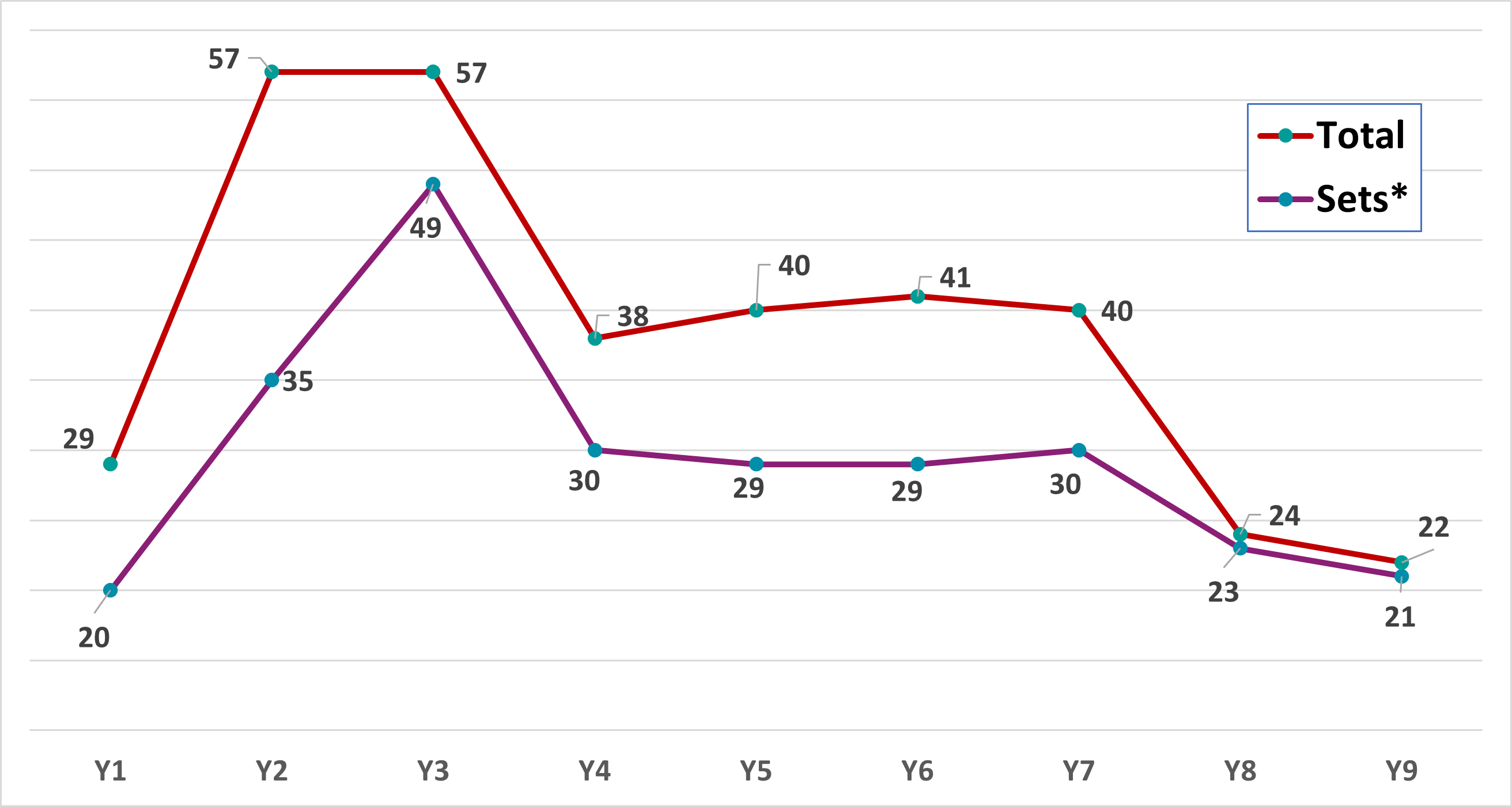
Of the approximately 348 actions started since the amendments, the majority (290, in grey below) were resolved prior to a decision on the merits of infringement and/or invalidity (in almost all such cases, prior to trial).
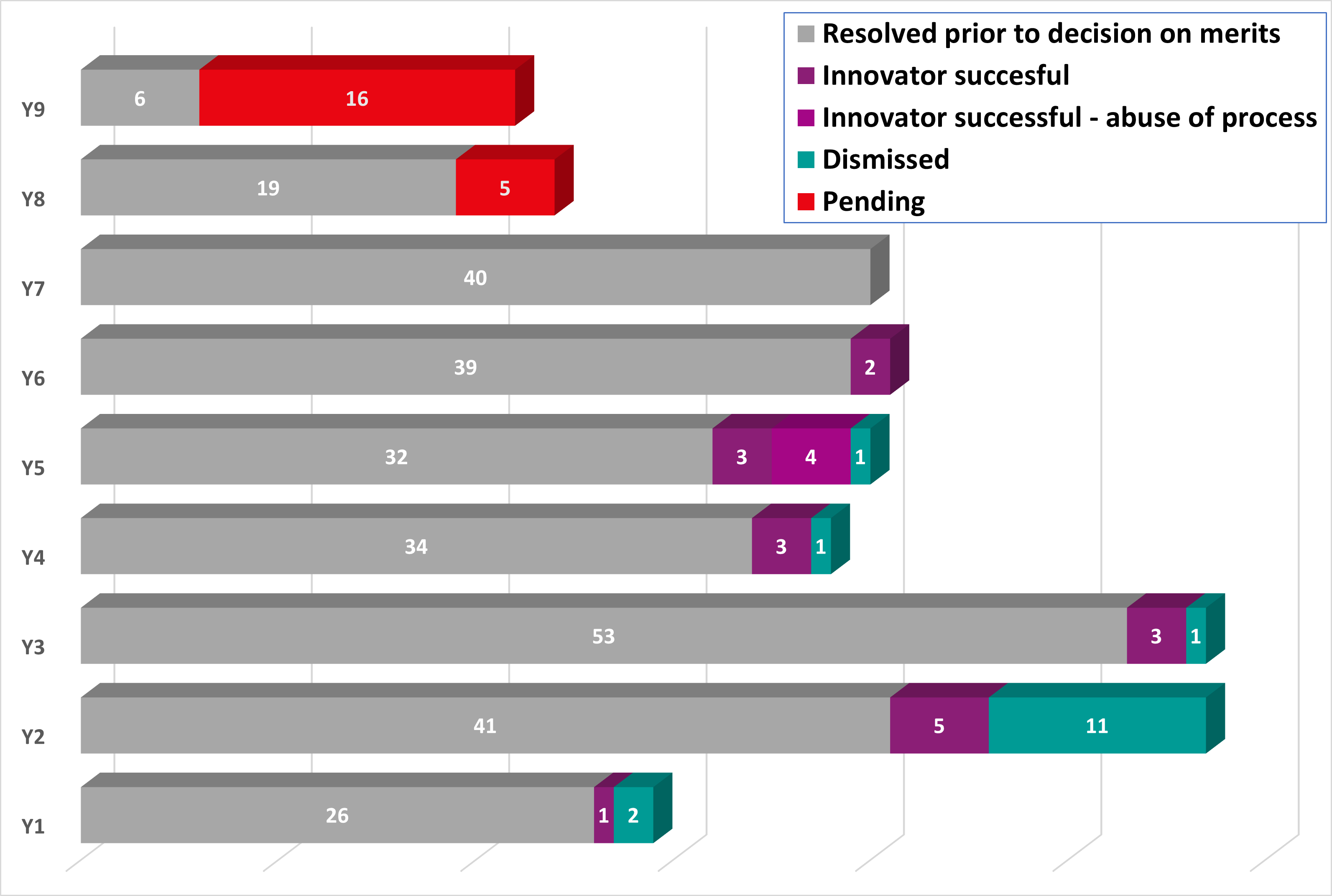
As there were no Federal Court decisions on the merits in the last year, the statistics on success remain the same as last year (see our eighth year update): the innovator was successful in 17 of the 33 actions pursued to a decision on the merits of infringement and/or invalidity.
To date, no trial decision has been overturned on appeal, and there are no appeals pending. In July, the Supreme Court of Canada released its decision in Pharmascience v Janssen. It held that Janssen’s patent claiming dosage regimens of paliperidone palmitate (INVEGA SUSTENNA) was valid, although methods of medical treatment are unpatentable subject matter.
The following 14 drugs have at least one action ongoing:
- apalutamide (Janssen’s ERLEADA)
- empagliflozin (Boehringer’s JARDIANCE)
- ivacaftor (Vertex’s KALYDECO)
- macitentan (Janssen’s OPSUMIT)
- mirabegron (Astellas’ MYRBETRIQ)
- olaparib (AstraZeneca’s LYNPARZA)
- pertuzumab (Hoffmann-La Roche’s PERJETA)
- rifaximin (Salix’s ZAXINE)
- ruxolitinib (Novartis’ JAKAVI)
- sacubitril and valsartan (Novartis’ ENTRESTO)
- secukinumab (Novartis’ COSENTYX)
- trametinib (Novartis’ MEKINIST)
- trifluridine and tipiracil (Taiho’s LONSURF)
- vortioxetine (Lundbeck’s TRINTELLIX)
In the last year, based on the number of drugs, Zydus was the most active challenger, named as a defendant in section 6(1) actions relating to three different drugs.
There is no deadline by which a biosimilar or generic manufacturer must serve a notice of allegation to address patents listed on the Patent Register. In the last year, a section 6(1) action was started a median of 2 months (average of 4 months) after the date the biosimilar or generic submission was accepted into review by Health Canada (the shortest was the same month and the longest was over two years). Health Canada issues monthly updates to lists of new drug submissions (including biosimilar drugs) and generic abbreviated new drug submissions accepted into review.
Actions pursuant to sections 8, 8.1 and 8.2 of the Regulations
Section 8 actions: To date, there have been no decisions on the merits regarding actions pursuant to amended section 8, and no such actions are currently pending.
Section 8.2 actions: Section 8.2 permits a first person/patentee to bring an infringement action asserting an unaddressed patent once served with a notice of allegation. In the past year, three actions were commenced under section 8.2 (for a total of 53 commenced since the amendments to the Regulations). Five actions are ongoing, relating to apalutamide (Janssen’s ERLEADA), secukinumab (Novartis’ COSENTYX) and trametinib (Novartis' MEKINIST).
Section 8.1 actions: Pursuant to section 8.1, a person who files a submission for a notice of compliance who has reasonable grounds to believe the drug might be alleged to infringe a patent is deemed an ‘interested person’ who may bring an action for a declaration of patent invalidity. In the last year, no actions were commenced under section 8.1 and there are no ongoing actions under section 8.1.
Actions beyond the Regulations
Apart from actions under the Regulations, there were six actions seeking declarations of infringement, invalidity and/or non-infringement commenced in the last year regarding biosimilar or generic drug products:
- Samsung Bioepis and Teva each brought actions for declarations of invalidity and non-infringement of patents regarding their respective proposed biosimilars of Merck’s KEYTRUDA (pembrolizumab). This follows similar actions by Sandoz brought last year. Notably, none of Sandoz, Samsung Bioepis or Teva had filed a new drug submission at the time of commencing the actions.
- Janssen commenced a patent infringement action against JAMP and its supplier Alvotech in respect of JAMP’s golimumab UPGOLYV (Janssen’s SIMPONI). Health Canada issued a Notice of Compliance for JAMP’s UPGOLYV in April 2026.
- Bristol-Myers Squibb started an action asserting that Amgen will infringe BMS’s patent with its nivolumab biosimilar ABP206 (BMS’s OPDIVO). Amgen’s new drug submission was pending at the time the action was commenced.
Summary proceedings and pending judicial review applications
The Federal Court released process guidance for summary judgment motions and trials in IP proceedings, including in actions pursuant to the Regulations. Prior to the release of the updated guidance, the Federal Court permitted a summary trial to proceed in a section 6(1) action between Novartis and Zydus regarding sacubitril-valsartan (Novartis’ ENTRESTO). The Court determined the infringement issue raised was suitable for summary trial and proceeding with the same would have the potential to save parties time and cost overall, as well as increase the likelihood of overall efficiencies to be gained by both the Court’s and parties’ resources.
In May 2026, Health Canada updated its guidance for biosimilar new drug submissions, which notably removed the requirement for comparative clinical efficacy studies. There are two pending applications for judicial review of decisions of the Minister of Health to accept biosimilar new drug submissions where the biosimilar manufacturer did not include or had not completed its comparative clinical efficacy studies:
- Novartis’ application regarding Celltrion’s new drug submission for CT-P55, a proposed biosimilar of COSENTYX (secukinumab).
- Hoffmann-La Roche’s application regarding Biosimilar Collaborations Ireland Limited (BCIL)’s new drug submission for its PEBRILZO product, a proposed biosimilar of PERJETA (pertuzumab).
In both instances, the biosimilar manufacturer served a notice of allegation regarding patents listed on the Patent Register once Health Canada accepted the biosimilar new drug submission as administratively complete. Patent infringement actions pursuant to the Regulations were commenced and remain pending.
Should you have any questions, please do not hesitate to contact a member of the Life Sciences Regulatory & Compliance Group or the Pharmaceutical Litigation Group.
The preceding is intended as a timely update on Canadian intellectual property and life sciences regulatory law. The content is informational only and does not constitute legal or professional advice. To obtain such advice, please communicate with our offices directly.
References
* Actions between the same parties regarding the same innovator reference drug are considered one “set”. The counts are provided as of the nine-year anniversary, September 21, 2026.